Ask your data. Act on the answer.
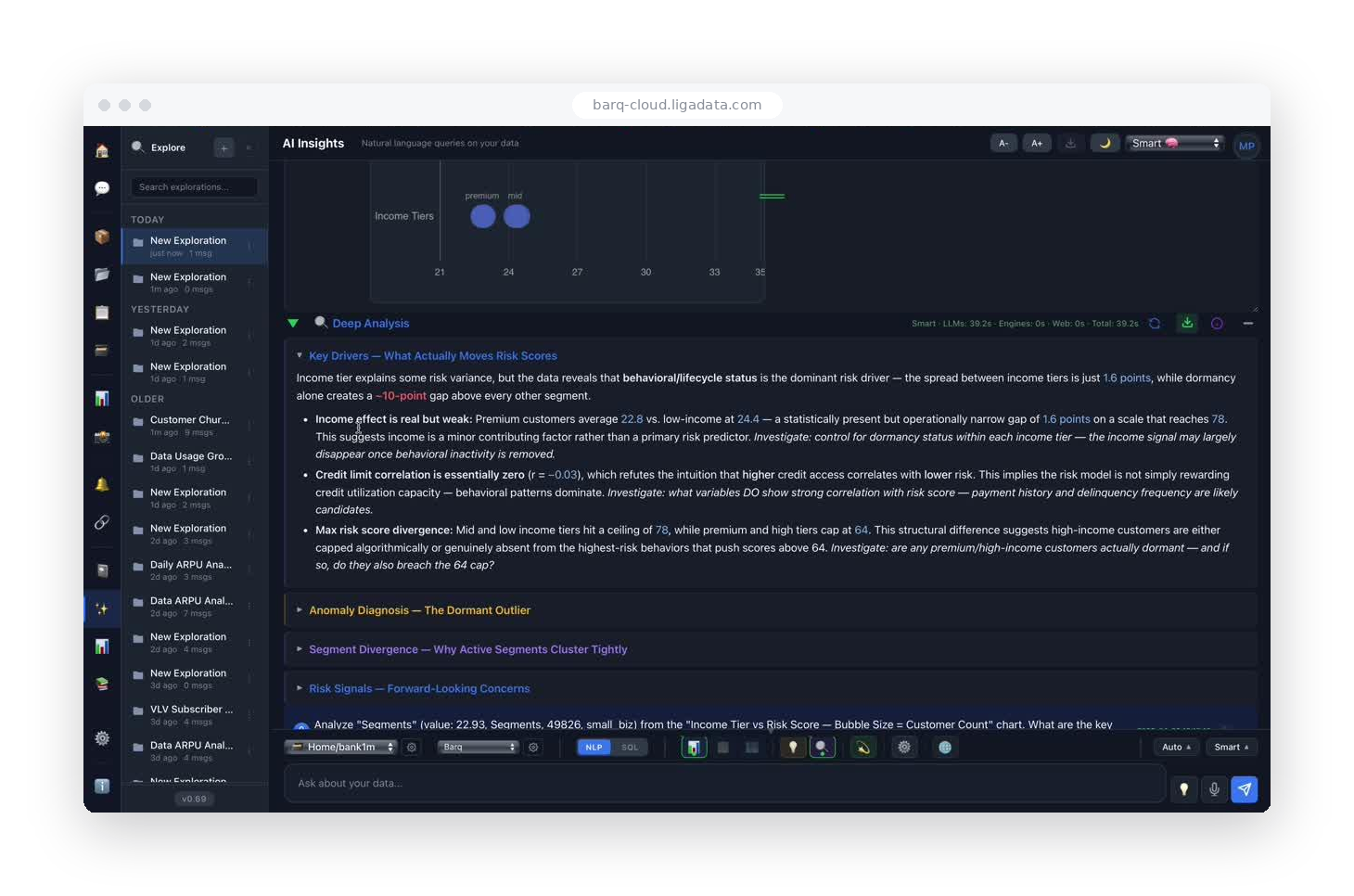
What a session looks like
Ask
One plain-language question becomes a verdict, structured tables, and an interpretation, in seconds.
Investigate
Named analysis sections, like an analyst sitting next to the executive, with drill-downs where charts are answers, not pictures.
Recommend
Actions grounded in this dataset’s actual findings, each tied to a specific number. Not an answer, a memo.
Plan honestly
When the data can’t answer directly, Barq says so, names what’s missing, proposes proxies, and writes its plan before running it.
Report
From one sentence to a board-ready report: headline, KPI table with traffic-light statuses, prioritized recommendations.
Audit
Execution mode, partition scans, rows scanned, and the query session ID, visible by default. Governance you can inspect, not a policy you trust.
What is Barq?
Barq is a governed data-to-decision layer from LigaData: business teams ask questions in plain language and get trusted, explainable answers computed from their own definitions, with a full audit trace behind every result, running where their data already lives. It is not a chatbot and not a dashboard.
Why teams choose Barq
Answers why, not just what
Barq explains what your data means, not only what it says. Governed results, sums, counts, rankings, trends, and charts, with a clear narrative explanation.
Grounded in your definitions
A Knowledge Model encodes your KPIs, entities, and business rules, so the numbers Barq gives you match the ones your business already trusts.
Works across your whole
governed data layer
Ask across domains, not inside one report or one semantic model.
Deployed where your data lives
On-prem or private cloud. You control the infrastructure, the access, and the data.
Auditable by design
A full execution trace sits behind every answer, so any result can be verified.
How does Barq ensure
data sovereignty? The
intelligence travels.
Your data doesn’t.
Barq brings the AI to your data, not the other way around. The AI and the Knowledge
Model run in LigaData’s cloud, and neither ever holds your data. When you ask a
question, what crosses to the AI is the question, the structure of your tables, and
governed aggregated context, never raw records, never PII. A governed query plan
crosses into your environment and executes there, where the engine works directly on
your data under your own access controls, and only aggregated results come back. Raw
data never leaves your environment. Sovereignty is guaranteed by architecture, not by
policy, and every access is governed and audited.
How does Barq govern AI agents?
An agent cannot grant itself more authority.
Barq includes agentic orchestration: agents that carry out multi-step work under the same governance as every answer. The control model is simple and strict.
Bounded authority
Every agent acts within an approved, least-privilege scope. Effective authority is the intersection of the user’s authority and the approved scope of the run, never more. Privilege escalation is impossible by design.
The agent proposes. The engine decides
A model or agent requests work. It does not create authority. Policy enforcement validates every data and tool request, and can allow, mask, constrain, require approval, or deny.
Actions pass through gates
When an agent acts on an external system, the action passes a policy gate that evaluates severity, reversibility, and volume. Credentials are resolved only at dispatch. The model never sees them.
Decision evidence
Every admission, request, and dispatch is recorded and traceable, so automation is something you can audit, not something you have to trust.
Barq integrates with agent orchestration frameworks, code harnesses like Claude and Codex, and downstream systems through APIs, so agents become part of how your enterprise runs, without becoming an exception to how it is governed.
Frequently asked questions
Is Barq a chatbot or a dashboard?
No. Barq is a governed layer between your data and your decisions. You ask in plain language and get governed, explained, traceable answers from your own definitions.
How does Barq ensure data sovereignty?
Barq’s engine executes inside your environment, working on your data under your own access controls. What leaves is only table structure and governed aggregated results, never raw records, never PII. Raw data never leaves your environment.
Can an agent exceed its permissions?
No. Privilege escalation is impossible by design: an agent cannot grant itself more authority. Every agent acts within an approved, least-privilege scope, and its effective authority is the intersection of the user’s authority and the approved scope of the run, never more.
Where does Barq deploy?
On-prem or in private cloud. You control the infrastructure, the access, and the data.
The Barq family
Barq Insights.
Ask your data in plain language and act on governed, traceable
answers. The experience described on this page.
Barq Command Center.
Governed agents that find waste and risk in your data infrastructure
and recommend the fix. Read-only by design, every action needs
your approval, and a running ledger shows what each
recommendation saved.